

“Each new situation requires a new architecture.”
– Jean Nouvel
ON THE RHINE RIVER, 2025
On a bright fall day, 2025, our cruise ship gently glided down the Rhine River in southern Germany. The view was spectacular. The hillsides were covered with vineyards, churches, and castles, in various states of repair. I sipped my drink, taking in this beautiful, glorious historic landscape. What caught my eye, however, were the many magnificent half-timbered framed buildings, some centuries old, standing along the river’s edge.

Whenever travelling, I always get caught up in a Country’s history. My trip up the Danube River, then along the Main River, and down the Rhine River was no exception. While the magnificent churches and castles, representing the elite few, are impressive, it’s the country’s folk history that I find intriguing. Part of that history is preserved in its architecture.
This story is about the history of European and Canadian timber building methods. What is the historical connection, and how does it manifest in folk log building architecture? What factors were responsible for the different log building construction techniques present on both continents during specific periods in history?
I’ve been a long-time admirer and student of historic folk architecture in the Americas. This fascination began when I first read about the 18th and 19th-century log construction techniques present during the western Canadian fur trade era. 1
My interest in folk building techniques didn’t stop with historic log construction methods. After visiting Iceland in 2022, I became fascinated by historic turf/sod houses in the Nordic countries and in Canada. But, to some degree, many of these structures, too, were timber-framed with sod infill. 2

LOG/TIMBER BUILDING TECHNIQUES
Before delving into the bewildering array and genesis of historic log or timber construction techniques, let’s first examine the composition of the most basic building log construction techniques.
1. Full-Timbered Horizontal and Vertical Log Buildings
Full-timbered buildings are entirely built of large, rounded or squared logs. The beauty of this method lies in its simplicity, which requires few tools for construction (e.g., axe, knife, drill/auger). There are two main types: 1) horizontally laid log walls, which were notched together at the corners of the building; 2) vertically oriented logs either resting on a horizontal foundation or placed into the ground. Both methods are referred to as Piece sur piece construction by the French and also described as ‘massed‘ log building construction.

While few tools were necessary to construct them, full-timbered log buildings required large, long, straight logs and either a pulley and rope system or many men to lift the top layers of heavy timbers into place.
2. Half-Timbered Building Construction
This technique uses rounded or squared timbers for the building’s skeleton or frame. The spaces between the frame timbers are filled with short, horizontal logs, brick, clay, rocks, or other materials. 3 The earliest forms were often filled with short horizontal logs when wood in Europe was plentiful (but large, long, straight trees were becoming scarce). As timber resources dwindled in Europe, other materials (listed above) were used as infills between the log frames. This building method was referred to as Colombage by the French. When we visited small Bavarian towns, we saw beautiful examples of half-timbered houses, some built in the 14th century (and still standing and occupied).


Half-timbered building construction techniques had several advantages over full-timbered building construction techniques: 1) they required less timber; and, 2) they allowed more variation or artistic freedom in the building’s facade. However, they were much more labour-intensive to build and required more joinery skills than the full-timbered horizontal log buildings with corner notching. 6 Also, because the timber frame was exposed to the elements, and the fill was of poor insulating quality, these houses were not as warm as a full-timbered log house.


In the German and French countryside, half-timbered farm buildings were common, but not nearly decorative as those in the towns and cities. Also, the farm house/barn was common in Germany and France, joining both the house and barn together for practical purposes and a lower expenditure of buildings resources.

A cursory examination of European log construction building methods through time and space indicates the following: 1) both methods were used in many European countries throughout the centuries; and, 2) the full-timbered horizontal log construction method with corner notching or vertical log timbered methods always preceded the half-timbered method.
And in every case, people abandoned the full-timbered construction method because by the Late Middle Ages (1300-1500 AD), suitable large, long, straight logs, necessary for full-timbered construction, became scarce in many areas of Europe, requiring people to use different materials for their infill instead of logs – hence the emergence of the half-timbered or the Colomblage building construction method. In regions where forests were patchy, the full-timbered and half-timbered method with horizontal log infill often occurred together, as it did in parts of western Ukraine.
We must also keep in mind that, all things being equal, the full-timbered horizontal corner-notched or vertical log building method produced a relatively warmer living environment than the half-timbered method. This was especially true if a layer of plaster or mud was applied to the outside and inside of the building’s walls.

Europeans Settle North America
The first Europeans to settle in the northern parts of North America in the early 17th century originated primarily from England and France. They brought with them their culture and traditions, including their building construction techniques. In historic Canada, we find both full-timbered and half-timbered building construction techniques, and hybrids thereof.
In France, Piece sur piece building construction was used in areas with abundant timber. In many regions, both styles were used concurrently, depending on local resources and the specific needs of the building. Half-timbering (of the Colombage style) became more common in areas where timber was less abundant or in cities where fire risk was higher (a combination of wood with non-combustible materials like stone and brick was safer). 9
After the medieval period (fifth to fifteen century), full log construction became less common in the British Isles, also because of a scarcity of suitable, large, straight timber. Alternatives were sought, and half-timber-framing, which used smaller, more efficient wooden members, or replaced them altogether with wattle and daub or brick infill, became the most common method of building construction.

CANADIAN FOLK ARCHITECTURE – DOES HISTORY REVERSE ITSELF?
Before I dive into the intriguing history of folk log/timber building in Canada and its origins, I introduce the concept of Nature versus Nurture. This concept, originally developed in the field of psychology, questions whether the human personality is a function of genetics or environment, or both. It has been readapted and applied to anthropology and history: are human traditions and customs a function of our collective culture history, personalities, our environment, or a bit of all of them?
In other words, when we examine folk architecture in Canada, why were certain techniques adopted, abandoned, or modified? This question has piqued my interest for many years. After visiting parts of Europe and studying the history of log/timber building construction methods in Canada, I’m convinced that in some (but not all) areas of Canada, the history of log/timber architecture is reversed from its historic development in Europe:
The half-timbered building construction method (Colombage) was first introduced in French Canada and then was replaced by the full-timbered (Piece sur piece) method, or modified adaptations thereof.
The Reason: A very Harsh Climate and Unlimited Timber Building Resources
Let me lay out the facts of my argument for you.
Early French Canada
According to C. W. Jefferys (1942), the earliest known log buildings, consisting of half-timbered buildings, were constructed in the 17th and 18th centuries in New France.

However, soon the French colonists, particularly in Quebec, adapted traditional Norman half-timbered techniques (known as maison à colombages or pan de bois) to the materials and climate of North America. They replaced traditional infill materials, such as wattle and daub, with local wood, stone and mortar (pierrotage), or a mixture of mud, moss, and animal hair (bousillage). But this transition to new building methods did not stop there.

As settlers adapted their building methods to the local climate and available materials, the half-timbered style evolved into more practical forms better suited to the harsh Canadian winters. The half-timber frame and infill methods were replaced by full-timbered horizontal or vertical logs (pièce-sur-pièce), offering better insulation. 13

To make the full-timbered or half-timbered house even warmer, the logs were covered with a layer of mud plaster.
I think French Canadians abandoned the traditional half-timbered building construction method to better cope with the harsh Canadian climate. There was also an unlimited supply of large, long, straight timber resources, which made the construction of full-timbered corner-notched buildings possible.
In French Canada, the history of log building construction technique was in the reverse order when compared to Europe. It started with the half-timbered method and then progressed to the full-timbered, corner-notched method.
In this case, it seems, Nature prevailed, necessitating this adaptation in French Canada.
Late 18th-Century and 19th-Century Western Canadian Fur Trade
The same log building pattern repeats itself in the early 18th and 19th-century fur trade and later 19th-century settlement in parts of western Canada, initially consisting of half-timbered building methods (using post-on-sill and post-in-ground foundation construction). Infill between the timber frame was, however, always logs because of suitable, abundant timber. 15

And, in some fort dwellings, the entire inside and outside walls were covered with thick layers of mud held in place by a willow latticework. 16

Then, around the 1870s, full-timbered horizontal log building construction began to appear at many fur trade posts in central and northern parts of western Canada, replacing the half-timbered building method. It is currently uncertain why this transition occurred. The greater permanence of forts may have led to the adoption of this technique. Also, a full-timbered horizontal log building, covered with a layer of plaster, would have been warmer than the half-framed building. For those who have experienced a northern Canadian winter, any insulation advantage would be important. However, why it took nearly 100 years to adopt it remains unclear.
Western Canadian Métis
“Our house, like all the others at that time in St. Norbert, was built from logs well squared off with a large axe and held superimposed by tenon and mortise joints and what we called in those days a ‘dovetail’. It was one and a half stories high, two times longer than wide and covered with earth and straw.” (Louis Goulet, born along the Red River in 1859) 17
The western Canadian Métis, whose origins are connected to the fur trade (where the companys’ male employees took First Nations female partners), also constructed their buildings using either full- or half-timbered construction methods. Log building traditions would have been passed down from father to son. In northern Alberta, Canada, with its vast timber resources, during the late 19th century, the Métis built their houses with full horizontal log walls with various types of corner-notching. 18

In Alberta, Canada, even during the 1930s, some Métis constructed their buildings from logs. The Baptiste River Métis used full-timbered horizontal building construction methods. They connected the large, round poplar logs covered in bark, at the corners, with an axe-hewn saddle notch.

Full-timbered horizontal log construction was the primary method used by Alberta Métis at the late 19th-century settlements, Carcajou, Buttertown (north Vermilion), Buffalo Lake, Tail Creek, and Baptiste River in Alberta. However, in parts of Saskatchewan and Manitoba, Canada, late 19th-century Métis half-timber framed buildings (where infill consists of short logs) often coexisting with full horizontal log-walled buildings.
When we look closer, for example, at the Métis settlement of Batoche (c.1872-1920), Saskatchewan, Canada, both construction methods were used. According to all sources the earliest Métis houses were of full-timbered horizontal log construction. Only the Saint Antoine de Padoue Church and the St. Antoine de Padoue Rectory, constructed later in 1883-1885, were built in the red river frame, but both buildings were built by the Oblate missionaries and not the Métis.

If my observations have any credence, adequate timber resources may have been the defining factor in the choice of log/timber construction methods by the late 19th century Métis. 21

Late 19th-Century Settlement in Western Canada
Ukrainian Settlers

Parts of western Canada were opened for settlement in the late 19th century. Large numbers of Ukrainian immigrants, primarily from the western regions of today’s Ukraine (originally the provinces of Galicia and Bukovyna of the then Austro-Hungarian Empire), settled in what was or would eventually become Manitoba, Saskatchewan, and Alberta. They brought with them their traditions, including their log/timber folk architecture. 23

Whenever I travel through parts of western Canada, I often come across mostly old full-timber structures having large horizontal logs with beautiful dovetailed corner notching. Many of these buildings are disappearing, but some refuse to go down easily. They speak to how well built they are and of Canada’s considerable ethnic diversity.

Like other parts of Europe, Ukrainians traditionally built their log buildings using various methods: “In the western Ukraine, where the majority of the immigrants to Canada originated, log construction was most common. There were three different construction methods used: horizontal log construction with dovetailed or saddle‐notched corners, post and fill (known as Red River Frame in western Canada) and vertical log construction in which the walls were secured by top and bottom sills. The horizontal construction method was favoured, but in areas deficient of good timber, post and fill construction was common. The vertical log method was used only occasionally.” 25

Early Ukrainian pioneers migrated to the western Canadian parkland and homesteaded large tracts of forested land. They had to clear the land, but for them, this was like finding a gold mine. There were many beautiful stands of mature trees to build their homes and farm buildings. During the time of immigration, many parts of Ukraine no longer had such vast timber resources.

In central and parts of northern Alberta, the early settlers built full-timber horizontal structures, even though many of them came from areas in the Ukraine where half-timbered building construction existed. I believe the reason people reverted to full-timber construction was its simplicity, requiring fewer tools. It was less labour-intensive and required fewer joinery skills than half-timbered construction. Also, there were abundant suitable timber resources in the Canadian parklands necessary for such construction. And of course, the brutally cold western Canadian winters likely played a role in the choice of log construction methods. Many of these houses contained a thick layer of plaster on the inside and outside walls.
However, according to John C. Lehr, in areas of Manitoba where Ukrainian full-timbered horizontal log construction and half-timbered construction coexisted, suitable wood for construction determined which building method Ukrainians chose:
“The type of log construction used by Ukrainian pioneers in Manitoba varied considerably. Horizontal logs corner-joined by saddle notchings was most widely employed but in areas where good building timber was difficult to obtain, post and fill, known locally as Red River Frame or Hudson’s Bay frame was often used. In some of the more marshy areas where any kind of mature timber was absent the Ukrainians used stockade walling with vertical timbers, but this method was used only infrequently. The Ukrainian immigrants were familiar with all three of these construction methods from their homeland…” 27

The same scenario is also present in parts of central Saskatchewan, Canada. A few years ago, Professor Emeritus, Dr. David Meyer, University of Saskatchewan, sent me images of half-timber framed buildings in the Radisson/Hafford area, northwest of Saskatoon, Saskatchewan, Canada. 29

At first, I thought these were old fur trade or Metis buildings, since a half-timber frame with log infill, also known as Red River Frame, occurred at many fur trade posts. Also, a few Ukrainian half-timbered buildings were present in Manitoba, but in Alberta, there are no recorded Ukrainian half-timbered buildings. But the written and oral evidence were irrefutable. These houses were built by Ukrainians who settled in central Saskatchewan during the early 1900s.
The wall infill of the Ukrainian houses in Saskatchewan consisted of short timber pieces mortised into the vertical corner and wall logs. This was a modification of the traditional half-timber framed buildings in the Ukraine that, because of declining forests, used other types of fill between the logs. Mud plaster also covered both the outside and inside of the building walls, making them quite comfortable to live in during the cold winter months. However, the exposed timber frame still acts as a cold bridge between the inside and outside of the house.

To make a long story short, it is possible that the central Saskatchewan half-timbered Ukrainian buildings were a product of inadequate timber resources required to construct the full-timbered horizontal log and corner-notched buildings. We base this interpretation on history, that, given a choice when adequate timber resources are present, humans will revert to the full-timbered corner-notched building methods, especially in a harsh winter climate such as the interior of western Canada.
Mennonite Settlers
Early Mennonites, immigrating from various parts of Europe in the late 18th century, also maintained some of their traditional building techniques while readopting others, such as log building construction in Canada. For example, they brought with them the conventional house/barn, which they built of full-timbered logs. Even though the house/barn was common in France and England, it was rare in historic Canada. 30

TIMBER BUILDING CONSTRUCTION: NATURE OR NURTURE?
Whenever we ask questions of history, especially why someone did something in a certain way, or in this case, why people in historic Europe and Canada built their houses in a particular way, we nearly always eventually confront the ‘nature versus nurture’ issue. When asked why they built a specific kind of house, people might say, ‘Well, that’s how my father built them and that’s how I learned to build them,’ Or, ‘I have to build this way now because good trees are sparse’, or, ‘There is a another way to build that make the house warmer in cold weather.
We humans are often reluctant to change the way we live or construct our dwellings. Our traditions hang heavy on us. But sooner or later, perhaps after freezing your arse off in the new French Canada, and spending endless hours cutting down trees for firewood to keep warm, it dawns on you that a different, more sustainable building technique was required to cope with the Canadian winters. The half-timbered framed houses of French, English and German Europe, with their various types of infill, were unsuitable for the harsh Canadian climate.
And once out west, any log structure, whether it was half-timber framed with log infill, or full-timbered horizontal log construction with notched corners, required thick layers of mud both on the outer and inner walls to be comfortable in the winter.
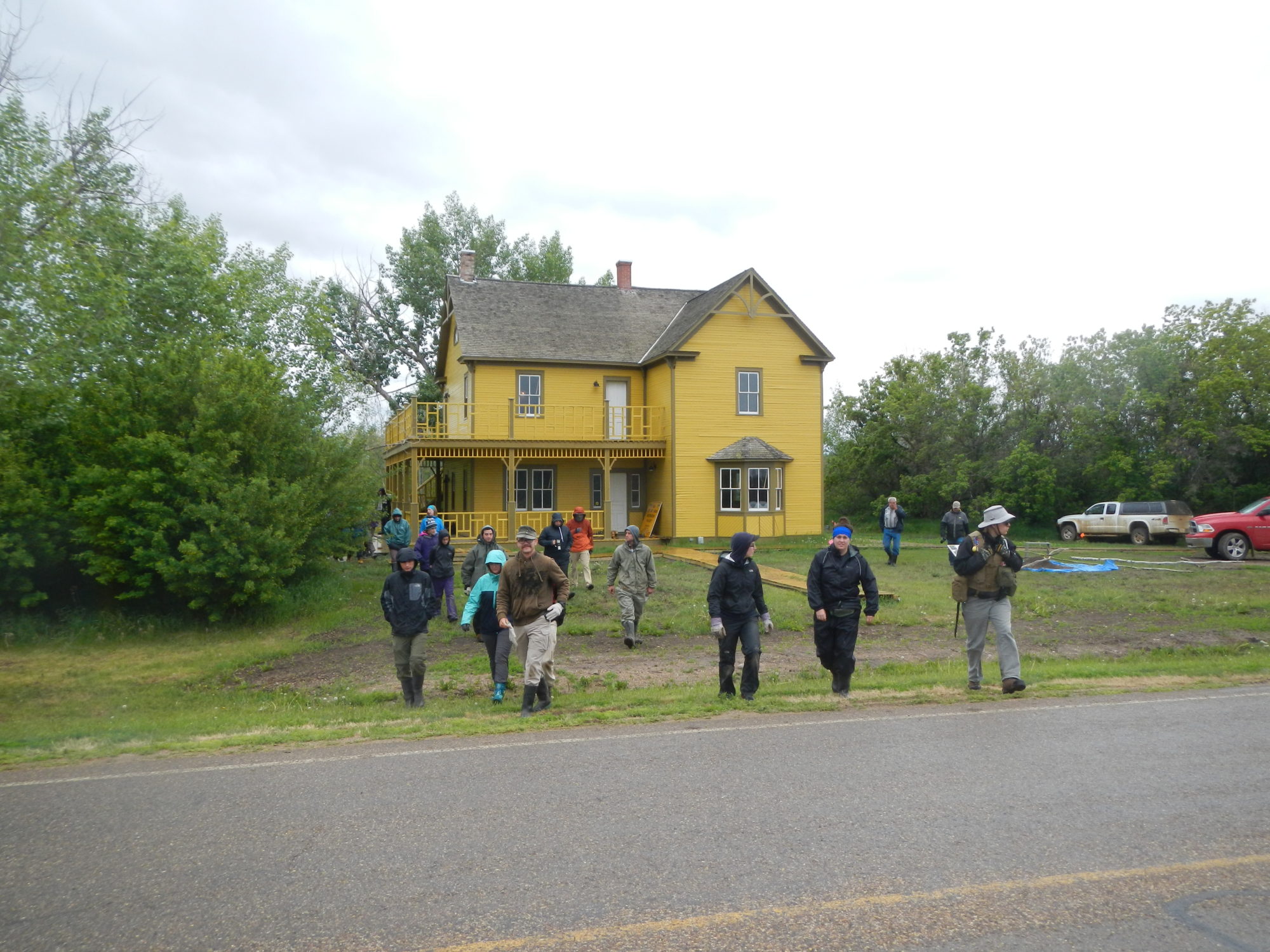
And, how far have we come when considering our modern building methods? Take a look at the photograph below. Yes, we have replaced logs with milled lumber, and mud, straw, stone, or brick infill with modern insulation. The cladding is wood, and still mostly plaster inside the house. But the building framing system is reminiscent of the historic half-timbered houses in Europe and North America.

These thoughts flashed through my mind as we drifted down the Rhine River or strolled through the streets of small towns in southern Germany, admiring the wonderful folk architecture.
Yes, the European castles and palaces are lovely, but they don’t represent the entire architectural histories of the peoples of either continent.

- Footnotes:
- For those of you interested in more details, read my blog: My Little Wooden House: Wood Building Techniques in Canada, published 2020/02/28[↩]
- For more information, see my blog: Ancient Turf Houses and the Canadian Connection, published 2022/09/20.[↩]
- Technically, if the infill was also of logs, the building would be full-timbered, since half-timbering refers to only the frame constructed of logs and infill consisting of other materials.[↩]
- Public Archives of Manitoba, N19472[↩]
- Photograph on the right, courtesy of https://www.wikiwand.com/en/articles/Timber_framing[↩]
- However, once the Colombage construction was adopted, fewer joinery skills were required.[↩]
- Photograph courtesy of Ukrainian Farm Buildings. An Architectural Theme Study. Ed Ledohowski & David Butterfield. Historic Resources Branch, Manitoba Culture, Heritage and Tourism.[↩]
- All images courtesy of Wikepedia: https://en.wikipedia.org/wiki/Low_German_house[↩]
- Areas in Normandy, Alsace, and Brittany had half-timbered houses during the medieval and Renaissance Periods. Examples still exist in towns and cities such as Strasbourg, Rouen, and Tours.[↩]
- Historic England Archives, DP261785[↩]
- Historic England Archives, DP039622[↩]
- Courtesy of Ontario Barn Preservation: Traditional Barns in Quebec. 2023. Arthur Plumpton[↩][↩]
- 2015, Architecture in New-France. https://maisondeplaisancedenouvelle-france.blogspot.com/2015/05/architecture-in-new-france.html[↩]
- Source: Early Building Construction, Jefferys, Charles W., 1942. The Picture Gallery of Canadian History Volume 1:82.[↩]
- In western Canada, the Hudson’s Bay Company and particularly the North West Company hired many French Canadians from French Canada, including carpenters.[↩]
- for more details on these methods, readers should refer to my earlier blog on log building construction techniques: My Little Wooden House: Wood Building Techniques in Canada, published 2020/02/28[↩]
- Louis Goulet in Guillaume Charette, Vanishing spaces: Memoires of a Prairie Métis. Winnipeg: Éditions Bois-Brûlés, 1976: 3-4.[↩]
- To my knowledge, the Métis in Alberta did not build half-timbered buildings, which they did in other parts of western Canada.[↩]
- I was involved in having this Métis historic settlement designated as a Provincial Historic Site, in recognition of Métis history in Alberta. At the time, my actions didn’t endear me to some of my colleagues at the Historic Resources Branch, Government of Alberta, who believed that the remains did not warrant protection and recognition. Currently, we have come a long way in recognizing that folk history, in its various forms, is as important to recognize and protect as the more grandiose buildings and places in Canada. Photographs courtesy of Beth Hrychuk, 1995. THE BAPTISTE SITE, ALBERTA, FdPs-1. RECONSTRUCTING TWENTIETH CENTURY &TIS LIFEWAYS IN ALBERTA. PERMIT 95-067. Archaeological Survey of Alberta.[↩]
- Photographs courtesy of: Gabriel Dumont Institute of Native Studies and Applied Research. https://www.metismuseum.ca/browse/index.php?id=624[↩][↩]
- However, without a larger sample size, and accurate building dates, it is currently impossible to say whether this is an absolute rule (i.e., all buildings…) or a relative rule (i.e., most buildings…) [↩]
- Provincial Archives
Manitoba[↩] - I have a soft spot for early western Ukrainian folk architecture, partly because of my interest in log/timber construction techniques of any sort, but also because my father’s family immigrated to Poland from western Ukraine sometime after 1920. My father was born in Lviv, Ukraine, in 1920 (which was in the province of Galicia). The family considered themselves German, but as my last name belies, there’s a strong Ukrainian connection in there somewhere.[↩]
- From: Ukrainian Farm Buildings. An Architectural Theme Study. Ed Ledohowski &
David Butterfield. Historic Resources Branch, Manitoba Culture, Heritage and Tourism.[↩] - From Ukrainian Farm Buildings. An Architectural History Study. Ed Ledohowski & David Butterfield. Manitoba Culture, Heritage, and Tourism. https://www.gov.mb.ca/chc/hrb/internal_reports/pdfs/ukrainian_buildings_full.pdf[↩][↩]
- From V.P. Samojlovych, Ukrains’ ke Narodne. Kyiv: Navakova Dumka, 1972[↩]
- John C. Lehr. Folk Architecture in Manitoba: Mennonites and Ukrainians. https: dalspaceb.library.dal.ca/server/api/core bitstreams/30582121-0c38-4504-a08a-410c7895a59b/content[↩]
- Photographs from: John C. Lehr. Folk Architecture in Manitoba: Mennonites and Ukrainians. https://dalspaceb.library.dal.ca/server/api/core/bitstreams/30582121-0c38-4504-a08a-410c7895a59b/content[↩]
- We (David Meyer, Wayne Lerch, Heinz Pyszczyk) are currently preparing a research paper for publication on these buildings, so my descriptions here are brief.[↩]
- French or English colonists in Canada rarely used this method of construction even though it was common in Europe.[↩]
- From: Traditional Period (1880 – 1900). Early Structures (1880-1885). Province of Manitoba. https://www.gov.mb.ca/chc/hrb/internal[↩]