

How Hard Can It Be?
Reading about history is simple enough. Replicating historic events, weaponry, clothing, or food practices is often much more challenging.
So, my friend Bob Dawe, Royal Alberta Museum, and I asked ourselves:
How hard can it be to pit roast approximately 240 pounds of fresh bison meat the traditional Blackfoot way?
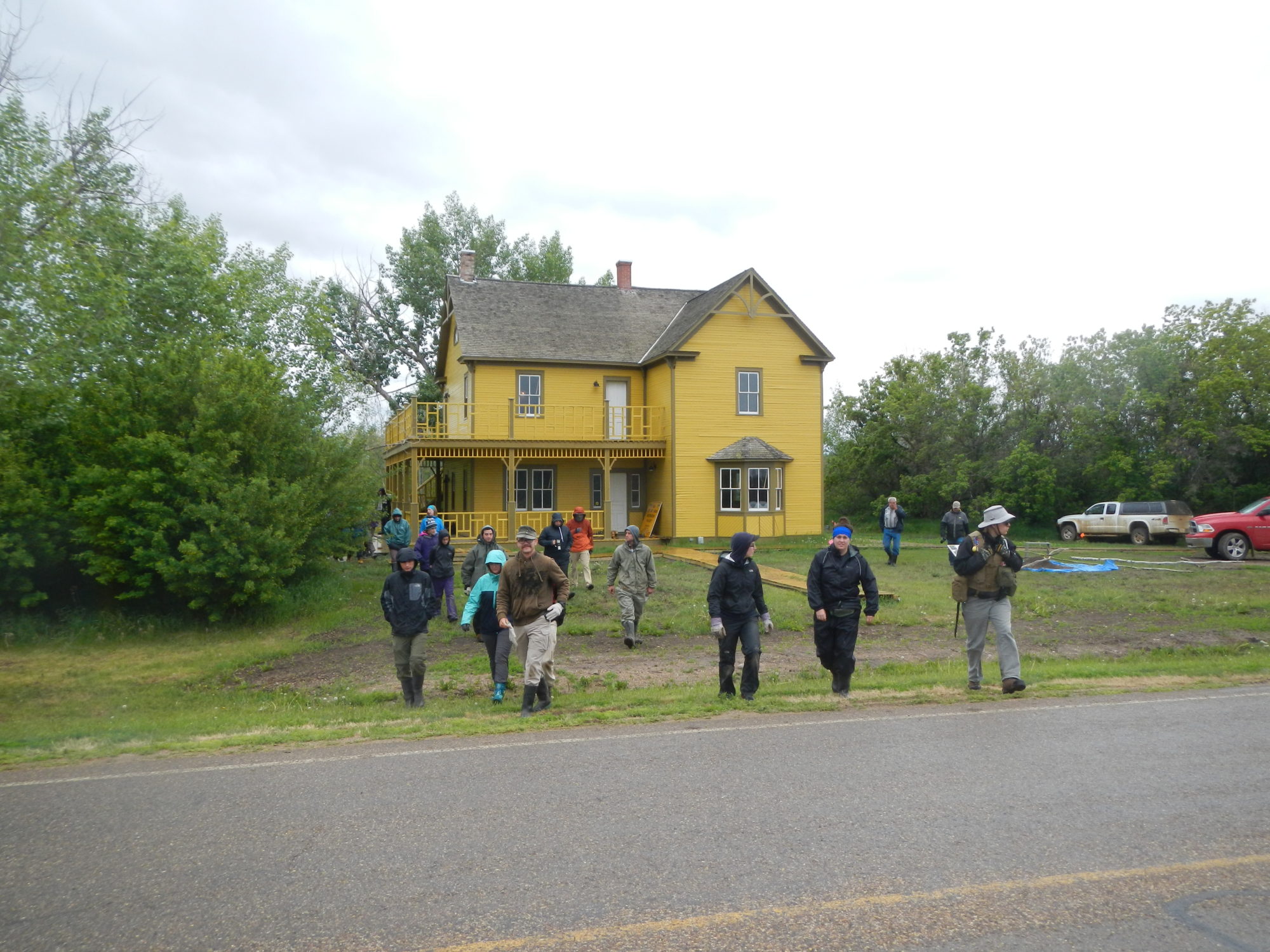
We read the historic literature describing Indigenous pit roasting. Bob bought the bison. I drove down to southern Alberta to help. We also had help from twenty-five archaeology field school students at Head-Smashed-In Buffalo Jump; they dug the roasting pit, collected the cooking rocks, firewood, sage, and willow needed for a successful roast.
While camping near the World UNESCO Head-Smashed-In Buffalo Jump in June 2026, we took up the challenge: roast all this meat in a pit and then have a feast with over fifty people attending.
Here’s an account of what went well and what we would do differently.
A Brief History of Pit Roasting Food
For thousands of years, people worldwide have prepared meats and vegetables in pits they dug into the ground. The food was either steamed, slow-cooked, or roasted depending on how the pit and food were prepared.

Here is a list (by no means exhaustive) of the traditional names of pit cooking and some of the regions/cultures that pit-cooked/boiled/roasted their food:
- Huatia – Andes region
- Curanto – Chiloé Archipelago
- Nakakoyonki – Aztec
- Rosvopaisti (robber’s roast) – Finnish
- Tandoor – India
- Imu – Hawaii
- Pib – Yucatan region, Mexico
- Asado – Argentina
- Mumu – Papua New Guinea
- Kleftiko – Greece
- Hangi – New Zealand (Māori)
- Barabicu – Caribbean (Arawak and Taíno people)
- Barbacoa – Mexico (Spanish)
- Baalbak’Kaab – Mayan term (meat covered with soil)
The modern word barbecue might have originated from one of the last three words on the list. Its origins and meaning, however, are debatable. Only the Caribbean Baribicu refers to the more popular North American method of cooking food over coals. The Mayan/Mexican versions refer to pit-roasted meat and vegetables.


By the 1755, barbecue was incorporated into the English language dictionary. It denoted smoking (low and slow), grilling (direct heat), or pit roasting (steam and heat) food.
North American Prehistoric Great Plains Pit Roasting
In North America, Indigenous people also devised various types of underground cooking systems that baked, steamed, and smoked food using retained heat. These methods go back thousands of years.
Texas
In southwestern Texas, for example, ancient burned rock middens are common. Archaeologist James E. Pearce of the University of Texas called these features kitchen middens. They were low, donut-shaped mounds of heat-fractured rocks and other cooking debris that accumulated over time from many baking episodes around a pit in the center of the midden. He believed they were made from numerous fires built within circles of stone to keep the fire contained for cooking and warmth. 4

Southern Alberta, Canada
Closer to home, at Head-Smashed-In Buffalo Jump (HSI), in southern Alberta, Canada, my colleague and friend Bob Dawe from the Royal Alberta Museum found evidence of meat-roasting pits while excavating in the jump’s processing area. Some pits dated back thousands of years.

Ethnologist, Clark Wissler, American Museum of Natural History, recorded Blackfoot accounts of cooking bison in a pit:
“A method of cooking in a hole was sometimes used for meats. At the time of the buffalo drive, a hole might be dug in the ground, many hot stones placed in the bottom and over these a layer of willow branches and grass. Next, a layer or two of foetal and newly born calves over which again were spread branches, grass and finally earth. This was spoken of as a dry cook. The hole was usually filled in the evening and by the following day it would be ready to uncover. A variation of this was similar to the mode of roasting camas. A hole was dug to the depth of four spans of the thumb and fore finger and lined with hot stones and brush as before. Dressed calves were wrapped in fresh hides, two hides spread over the brush, water poured in, the calves quickly placed and the whole covered with two more fresh hides. The upper hide was stretched and staked. Then the earth was heaped over all and a fire kindled on top” 6
Certainly, other variations of this method likely existed, but were never recorded.
How to Pit Roast Two Hundred and Forty Pounds of Bison Meat
Below is a blow-by-blow description, and accompaying photographs, of our bison roasting pit experiment. We started our little adventure around 3:30 pm on June 19th, 2026.
First, we (well, the students did the digging) dug a sizable hole in the prairie. Fortunately, the sediment was not prairie clay, but a mixture of sand and some gravel. The digging was relatively easy.

Next, we lined the bottom of the pit with a layer of large rocks. We chose quartzite because, unlike limestone, sandstone, or shale, quartzite may crack when fired but won’t explode sending dangerous shrapnel in all directions.

We then built a roaring fire over the rocks to heat them and create a hot bed of coals.

After about two-three hours of burning, the pit temperatures reached over 1,000°F. We then threw in a second layer of smaller quartzite cobbles on top of the coals. The 140 cobbles weighed 358.3 kg or 790lbs. We then placed more wood on top of the quartzite cobbles and, for the next several hours, continued to feed the fire until the quartzite cobbles were red hot and the wood was reduced to glowing coals.

Meanwhile, a few students and Bob prepared the meat for cooking. Our butcher had cut a bison forequarter and hindquarter into approximately two halves for cooking. On average, each piece weighed approximately sixty pounds.

According to nutritional facts, bison meat is very healthy. It is very low in fat, calories, and cholesterol when compared to other meats. Also, it is very high in iron. 7
Our cooks rubbed coarse salt into thin linear incisions cut into the outer surface of the meat. Then they wrapped each large chunk of meat in layers of wet burlap. They further fastened the entire bundle with wire wrapped around it to keep it from falling apart.
I inserted two thermometers into the densest pieces of meat to monitor the internal meat temperature while it cooked. The wires attached to the thermometers stuck out of the covered pit and could be attached periodically to electronic displays.

Once the fire burned down and the coals and rocks were red-hot, we covered them with a layer of wet willow branches. The willow had been soaking in the cattle trough for twenty-four hours. Next, the students placed the four chunks of wrapped meat on the wet willow bed, creating searing-hot steam which made it very difficult to get near the pit.

Once we placed the meat in the pit, we added another layer of wet willow branches to cover it. I also added about four handfuls of crushed prairie sage to give the meat some flavour. I was careful, however, about how much to use. Too much of the strong-scented sage might give the meat too strong a taste. There was no recipe to follow, so I erred on the conservative side. Once we tasted it, we didn’t notice any sage flavour in the cooked meat.
I took internal temperature readings of the forequarters and hindquarters (42°F and 44°F, respectively) with the two electronic probes before we covered the meat. For it to be well done, the bison meat internal temperature needed to reach 170°F or slightly higher.
I worried that because my probes were on top of the meat near the edge of the pit so I could reach them, they might not accurately read the internal temperatures of meat lying further from the pit’s edge. But there was no way around this problem. The wire couplings weren’t long enough to extend further into the roasting pit. I also wanted to determine the roasting pit ambient temperature during the cook, but my third thermometer failed.
After taking my readings, we covered the wrapped meat with at least 15cm (~six inches) of sediment. The objective was to seal the pit completely with the sediment to prevent any heat or steam from escaping. We did not add a tarp or other fireproof covering to prevent heat loss. Once the students had filled the pit in and the dirt slightly packed with shovels, we saw no evidence of heat escaping anywhere. It was now 10:55 pm, June 19th, 2026.

Bob and I stayed up all night and checked the internal temperature of the cooking meat approximately every two hours. At first, progress was slow. Even after two hours, the surface sediment of the pit was still cool to the touch and internal meat temperatures remained low. The cold ground surface caused a little consternation. But then we realized this meant the pit was well sealed to retain the internal heat, not escaping to the surface. Below are our readings of the internal meat temperatures over the next 19.5 hours.
| Date/Time | Probe #1 (°F) | Probe #2 (°F) |
| June 19, 10:55 pm | 42 | 44 |
| June 20, 1:04 am | 59 | 60 |
| June 20, 3:00 am | 73 | 93 |
| June 20, 4:00 am | 119 | 109 |
| June 20, 6:00 am | 149 | 145 |
| June 20, 3:24 pm | 167 | 170 |
| June 20, 5:01 pm | 168 | 170 |
| June 20, 6:31 pm | 168 | 170 |
During the last three hours of cooking, our internal meat temperatures did not significantly rise. By six-thirty pm, the over fifty people who would partake in the feast were getting hungry.
It was time to open up the pit and hope for the best….

Once we got the meat back to camp and unwrapped it, it fell off the bone and was still very moist. Bison meat is leaner and finer grained than regular beef. Bob and I were worried the lean meat would dry out after 19.5 hours of cooking. But because the pit was sealed, releasing little moisture, the meat stayed moist and tender.


Well done, HSI field school students, 2026. Well done!
It was only fitting that the students excavating a Canadian Plains bison jump try bison cooked in one of the traditional Blackfoot ways. Most even tried the fat-rich marrow, which was a delicacy for Indigenous peoples and the first traders in western Canada.

Despite it being our first attempt, the bison pit roast was a success.
In retrospect, we would do a few things differently to improve it:
- We need to devise a better method to lower the heavy bundles of meat into the large, dangerously hot roasting pit.
- The meat portions should be more securely wrapped and tied, making them easier to handle when removing them from the pit. We weren’t prepared for well-cooked meat falling off the bone in wobbly burlap that tore easily after nearly twenty hours of cooking.
- Placing a thermometer in the pit to record ambient pit temperature would reduce guesswork. The internal meat temperatures stopped increasing after about fifteen hours. I wasn’t sure if it was because the pit ambient temperature had dropped or if we hit that point in cooking where internal meat temperatures often stall while trying to break down toughest fat and muscle tissue. This happens to me when smoking brisket. Temperatures will often stall at the end of the cook before the meat is finally done and falling off the bone.
- Drinking less scotch throughout the night might have led to more regular monitoring of the meat cooking the next day. However, this suggestion shouldn’t be taken too seriously.

- Ōtaki, New Zealand, in 1936. Photograph by Leslie Adkin. From the Museum of New Zealand Te Papa Tongarewa. Courtesy of Facebook post ‘Eating History, January 2025. https://www.facebook.com/100064707491814/posts/a-hangi-steam-oven-with-potatoes-eels-fish-heads-etc-in-position-on-hot-stones-b/1002637151903192/[↩]
Courtesy of https://commons.wikimedia.org/wiki/File:Maori_earth_oven.svg[↩]- https://en.wikipedia.org/wiki/Barbacoa#/media/File:Barbecue_Virginia_Barbacoa.jpg[↩]
- From Texax Beyond History: Camp Bowie. https://www.texasbeyondhistory.net/bowie/middenwhat.html[↩]
- https://open.alberta.ca/dataset/16612edd-ae18-4795-817d-3e7a8ea56326/resource/ce72638b-bbde-43c4-a890-aa90e50f24ca/download/acsw-occasional-paper-42-dawe-roasting-pit.pdf[↩]
- Wissler, C. 1910. Material Culture of the Blackfoot Indians. Anthropological Papers of the American Museum of Natural History 5:25,26[↩]
- Source of chart: “Super Easy Bison Roast Technique – and a Profile of a Canadian Bison Farmer”, In Kitchen Frau. 2022. https://www.kitchenfrau.com/super-easy-bison-roast-technique-and-a-profile-of-a-canadian-bison-farmer/[↩]